
Key insight: Data centers consume large amounts of energy and water. This high water consumption in data centers is mainly due to cooling systems required to maintain servers at safe operating temperatures.
These infrastructures are the backbone of the digital economy, but their environmental footprint is becoming a critical constraint for the future of cloud computing.
What is a data center?
A data center is a physical facility used to store, process, and distribute large amounts of digital data through servers and networking systems.
Why do data centers consume so much energy?
Data centers require large amounts of energy to power servers continuously and to support cooling systems that prevent overheating.
- Servers operate 24/7
- High computational demand increases energy use
- Cooling systems require additional power
Electricity consumption: data centers account for approximately 1.5% to 2% of global electricity consumption, according to the IEA World Energy Outlook 2023. With the growth of generative AI, this figure could increase significantly by 2030.
Why do data centers have high water consumption?
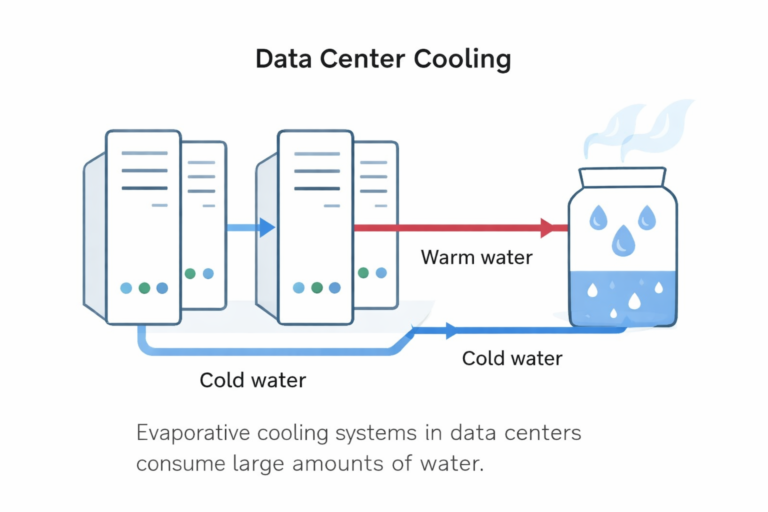
Data centers use water mainly for cooling. Evaporative cooling systems dissipate heat efficiently, but they also require large volumes of freshwater.
In simple terms, water helps remove the heat generated by intensive computation.

How much water do data centers consume?
A large data center can consume millions of litres of water per day, depending on its size, location, and cooling technology.
Water consumption: many facilities use evaporative cooling systems, which implies large volumes of freshwater. In some cases, a single large site can consume millions of litres per day.
The perceived imbalance lies in the competition with human needs such as water for households or agriculture.
Environmental impact: energy and water
The environmental impact of data centers comes from both energy consumption and water use.
- Electricity demand contributes to carbon emissions
- Water consumption affects local resources
- Location determines environmental pressure
Can data centers be sustainable?
Data centers can improve sustainability through renewable energy and more efficient cooling technologies, but trade-offs remain.
Water consumption, in particular, is not always avoidable and depends on infrastructure design.
The hidden constraint of the cloud
The cloud is often perceived as intangible, but it relies on physical infrastructures with real environmental limits.
Water availability may become a key constraint shaping the future of digital infrastructure.
Key takeaways
- Data centers consume both energy and water.
- Cooling systems are the main driver of water use.
- Environmental impact depends on location and design.
- The future of the cloud is constrained by physical resources.
Stakeholder positions
Industry (Big Tech)
- Data centers are becoming increasingly efficient.
- Companies invest in renewable energy and aim to become water positive by 2030.
- Digital technologies and AI can also support the ecological transition.
Government and regulators
- Some regions (such as the Netherlands or Ireland) have imposed limits or moratoria due to pressure on energy grids and water resources.
- The EU is developing regulations under the Green Deal to monitor and reduce the environmental footprint of data centers.
Civil society
- There are protests against facilities in drought-prone areas (e.g. California or Catalonia).
- There is increasing demand for transparency and environmental accountability.
Energy and sustainability experts
- Digital demand is growing faster than efficiency gains.
- AI and high-quality streaming are major drivers of consumption.
Proposed options and solutions
- Efficiency improvements: free-air cooling, liquid immersion, and reuse of waste heat.
- Strategic location: placing data centers in colder regions or areas with abundant water and renewable energy.
- 100% renewable energy: powering facilities with solar, wind, or hydro sources.
- Water recycling and reuse: reducing reliance on potable water through treatment systems.
- Regulation: efficiency caps, mandatory reporting, and local environmental compensation measures.
- Alternative architectures: edge computing to reduce dependence on large centralized facilities.
-
- 100% renewable energy: corporate commitments to power facilities exclusively with solar, wind, or hydro.
-
- Water recycling and return: treatment systems that reduce potable water extraction.
-
- Regulation: efficiency caps (e.g. PUE < 1.2), mandatory publication of consumption data, and local compensations.
-
- Alternative technologies: leveraging edge computing to reduce reliance on large-scale facilities.
Where we stand
Transition underway: major companies announce sustainability targets, but there is still no binding global standard.<
- Intense debate: regulators and communities are increasing pressure, especially in Europe and the US.
- Risk: the AI boom may offset efficiency gains achieved so far.
- Trend: growing demands for transparency and mandatory regulation rather than self-regulation.
Legislation and policies in progress
-
EU Energy Efficiency Directive (revised EED)
- Obligations to monitor and report data center energy performance.
Energy Efficiency Directive - Incorporates performance indicators (KPIs) including water footprint and sustainability.
- Includes requirements to reuse or recover waste heat in new facilities.
EED impact report
- Obligations to monitor and report data center energy performance.
-
Climate Neutral Data Centre Pact (Europe)
- Industry initiative supported by the EU aiming for climate neutrality by 2030.
- Includes targets such as renewable energy use, equipment recycling, and water conservation.
-
Transparency and reporting
- Increasing requirements for public reporting of energy and water consumption.
European Parliament example
- Increasing requirements for public reporting of energy and water consumption.
-
Other regional regulations
- Examples such as Australia highlight concerns about unclear water-use commitments.
Reuters - Future regulations may include minimum standards for efficiency, water use, and heat recovery.
- Examples such as Australia highlight concerns about unclear water-use commitments.
Projects and technologies of interest
- Quincy Water Reuse Utility (USA): water treatment systems allow reuse of cooling water, reducing dependence on potable water.
US EPA - Veolia data center solutions: optimisation of cooling cycles to reduce water and chemical consumption.
Case study - Project Natick (Microsoft): underwater data centers using natural cooling conditions.
- iDataCool (Germany): hot-water cooling combined with waste heat reuse.
- Circular water solutions: reuse of wastewater, rainwater, and closed-loop systems (potential savings of 50–70%).
World Economic Forum - Multi-objective optimisation frameworks: balancing energy cost, carbon footprint, and water usage through workload distribution.
arXiv
Arguments
In favour
- Digital services are essential for modern society (AI, streaming, telemedicine).
- Continuous technical improvements increase efficiency.
- Potential to reuse waste heat for other applications.
- Growing regulatory and social pressure towards sustainability.
Against
- Demand growth (AI, streaming) may outpace efficiency gains.
- Water scarcity in already stressed regions.
- Lack of transparency in consumption data.
- Higher cost of sustainable technologies.
- Secondary environmental impacts depending on energy sources.
Where we are
- There is a clear trend towards stricter regulation, especially in Europe.
- Demand for transparency in water and energy consumption is increasing.
- Interest in alternative cooling technologies and strategic locations is growing.
- There is a risk of infrastructure expansion without sufficient environmental guarantees.